beginning and intermediate algebra pdf
Beginning and Intermediate Algebra PDF: A Comprehensive Guide
Beginning and Intermediate Algebra PDFs offer accessible, affordable resources for STEM students, reflecting evolving developmental math needs as of today, 04/15/2026.
What is Beginning and Intermediate Algebra?
Beginning and Intermediate Algebra bridges the gap between basic arithmetic and more advanced mathematics, preparing students for STEM fields. These courses, often combined, cover fundamental algebraic concepts. Resources like those by Hendricks & Chow (2013), Martin-Gay, Miller, and Wallace (Lulu.com, 2010) provide comprehensive instruction.
PDF formats from sources like Internet Archive and CCfaculty.org offer free access, supporting diverse learning styles and reducing financial burdens for students.
The Need for Accessible Resources (as of 04/15/2026)
As of today, 04/15/2026, developmental math students require more than just the math; they need support for college success. Accessible Beginning and Intermediate Algebra PDFs, like those on Internet Archive and CCfaculty.org, reduce financial burdens.
Instant access to materials via platforms like MyOpenMath and integrated e-books are crucial, addressing diverse learning styles and unfamiliarity with college strategies;
Popular Textbooks and Authors
Several authors contribute significantly to Beginning and Intermediate Algebra resources. Andrea Hendricks and Pauline Chow’s (2013, ISBN 9780077491413) work acknowledges the changing student landscape. Elayn Martin-Gay and Julie Miller offer widely used texts available via Internet Archive.
Tyler Wallace’s (Lulu.com, 2010, 489 pages) Creative Commons edition on CCfaculty.org provides a free, accessible option.
Andrea Hendricks and Pauline Chow’s “Beginning & Intermediate Algebra” (2013)
Hendricks and Chow’s 2013 textbook (ISBN 9780077491413) directly addresses the evolving needs of today’s developmental math students. Recognizing increased demands beyond core math skills, their approach supports diverse learning styles and students unfamiliar with college success strategies.
This resource aims to provide instant access to materials, integrating e-books, notes, and videos.
Elayn Martin-Gay’s “Beginning and Intermediate Algebra”
Elayn Martin-Gay’s work is readily available through the Internet Archive for free download, borrowing, and streaming. This accessibility is crucial, especially considering the financial burdens students face. The Internet Archive encourages publishers to restore access to vital resources, like textbooks, benefiting countless learners.
Her textbook supports STEM fields and offers comprehensive coverage.
Julie Miller’s “Beginning and Intermediate Algebra”
Julie Miller’s “Beginning and Intermediate Algebra” is also accessible via the Internet Archive, offering students free download, borrowing, and streaming options. This resource addresses the growing need for affordable educational materials, reducing the financial strain on learners.
The Internet Archive actively seeks to restore access to a vast collection of books.
Tyler Wallace’s “Beginning and Intermediate Algebra” (Lulu.com, 2010)
Tyler Wallace’s “Beginning and Intermediate Algebra,” published by Lulu.com in 2010, is available as a Creative Commons Edition on CCfaculty.org. This 489-page textbook offers a free eBook in PDF format, licensed under CC BY 3.0.
It’s a valuable resource for students seeking accessible learning materials.
Key Topics Covered in Beginning Algebra
Beginning Algebra fundamentals encompass real numbers and operations, alongside mastering variables and expressions. Students learn to confidently solve linear equations and navigate inequalities and absolute value.
Crucially, the course builds skills in graphing linear equations, providing a visual understanding of algebraic concepts and preparing students for more advanced topics.
Real Numbers and Operations
Real Numbers and Operations form the bedrock of algebra, covering integers, rational, and irrational numbers; Students master arithmetic – addition, subtraction, multiplication, and division – alongside order of operations (PEMDAS).
Understanding properties like commutativity and distributivity is vital. These foundational skills are essential for success in subsequent algebraic concepts and problem-solving.
Variables and Expressions
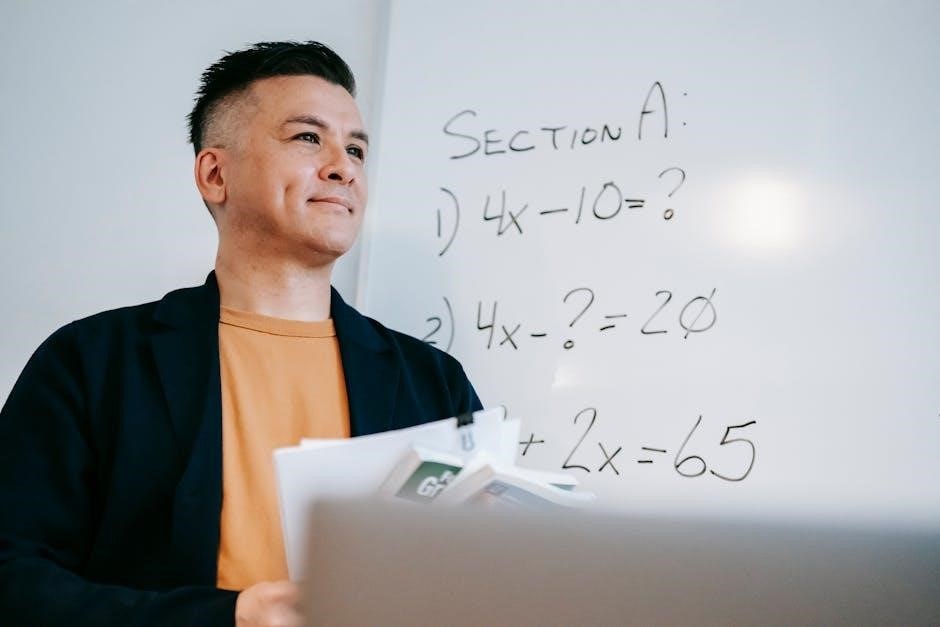
Variables and Expressions introduce symbolic representation in algebra. Students learn to translate word phrases into algebraic expressions, utilizing variables to represent unknown quantities.
Simplifying expressions by combining like terms and applying the distributive property are key skills. Evaluating expressions by substituting numerical values for variables builds a crucial foundation for equation solving.
Solving Linear Equations
Solving Linear Equations is a cornerstone of beginning algebra. Students master techniques to isolate variables using inverse operations – addition, subtraction, multiplication, and division – maintaining equation balance.
This involves simplifying equations, combining like terms, and applying the distributive property. Practical applications and word problems reinforce understanding, preparing students for more complex algebraic concepts.
Inequalities and Absolute Value
Inequalities and Absolute Value build upon linear equation skills, introducing symbols like <, >, ≤, and ≥. Students learn to solve inequalities, understanding how multiplication or division by a negative number flips the inequality sign.
Absolute value concepts explore distance from zero, leading to solving equations and inequalities involving absolute value expressions, crucial for further mathematical study.
Graphing Linear Equations
Graphing Linear Equations visually represents solutions, utilizing the Cartesian coordinate plane. Students learn to plot points, determine slope and y-intercept, and translate equations into graphical form.
Understanding slope-intercept form (y = mx + b) is key, alongside techniques for finding x and y intercepts. This skill bridges algebraic representation with visual interpretation, essential for STEM fields.
Key Topics Covered in Intermediate Algebra
Intermediate Algebra builds upon foundational concepts, delving into Systems of Linear Equations, solved through graphing, substitution, and elimination. Polynomials and Factoring are explored, leading to solving Quadratic Equations.
Further topics include mastering Rational Expressions and Equations, and tackling Radical Expressions and Equations, preparing students for advanced STEM coursework.
Systems of Linear Equations
Systems of Linear Equations represent a crucial component of Intermediate Algebra, demanding proficiency in multiple solution methods. Students learn to solve for variables using graphing, visually identifying intersection points.
Substitution and elimination techniques provide algebraic approaches, enhancing problem-solving skills essential for STEM disciplines. Mastering these skills builds a strong foundation.
Polynomials and Factoring
Polynomials and Factoring form a cornerstone of Intermediate Algebra, building upon earlier algebraic concepts. Students delve into operations with polynomials – addition, subtraction, multiplication, and division – mastering techniques for simplification.
Factoring polynomials, including techniques like greatest common factor, difference of squares, and trinomial factoring, is vital for solving equations and simplifying expressions.
Quadratic Equations
Quadratic Equations represent a significant step in Intermediate Algebra, extending beyond linear equations. Students learn to solve these equations using various methods, including factoring, completing the square, and the quadratic formula.
Understanding the discriminant’s role in determining the nature of roots – real, distinct, or complex – is crucial. These skills are foundational for STEM fields.
Rational Expressions and Equations
Rational Expressions and Equations build upon foundational algebraic skills, introducing fractions with polynomials. Students learn to simplify these expressions, perform operations like addition, subtraction, multiplication, and division, and solve related equations.
Identifying extraneous solutions is vital, alongside understanding restrictions on the variable to avoid division by zero – key for STEM applications.
Radical Expressions and Equations
Radical Expressions and Equations extend algebraic manipulation to include square roots, cube roots, and other radicals. Students master simplifying radicals, converting between radical and exponential forms, and solving equations containing radicals.
Crucially, they learn to identify and eliminate extraneous solutions that can arise when raising both sides of an equation to a power.
Where to Find Free PDF Resources
Free PDF resources for Beginning and Intermediate Algebra are increasingly available online. Internet Archive (archive.org) provides access to scanned textbooks, including editions by Elayn Martin-Gay and Julie Miller.
CCfaculty.org offers a Creative Commons Edition of Tyler Wallace’s textbook, licensed under CC BY 3.0, providing a legally free and accessible option for students.
Internet Archive (archive.org)
Internet Archive hosts digitized copies of various Beginning and Intermediate Algebra textbooks. Students can download or borrow books by authors like Elayn Martin-Gay and Julie Miller.
The platform encourages publishers to restore access to books, currently holding around 500,000 titles. User privacy is prioritized, with no information sold or shared.
CCfaculty.org (Creative Commons Edition)
CCfaculty.org provides a Creative Commons Edition of Tyler Wallace’s Beginning and Intermediate Algebra, licensed under CC BY 3.0. This resource is available as a free eBook in PDF format.
The textbook spans 489 pages and offers an accessible alternative, supporting students with readily available materials for STEM coursework.
Utilizing Online Platforms
MyOpenMath (myopenmath.com) serves as a valuable platform for STEM courses utilizing these algebra resources. Students gain instant access to the e-book, supplementary notes, and instructional videos.
This integrated approach minimizes the financial burden on students, providing comprehensive materials for assignments and learning, enhancing the overall educational experience.
MyOpenMath (myopenmath.com) for STEM Courses
MyOpenMath provides a robust online environment specifically tailored for STEM students studying Beginning and Intermediate Algebra. It delivers instant access to crucial course materials, including the digital textbook and supplementary resources.
Students benefit from integrated notes and explanatory videos, fostering a deeper understanding of key concepts and streamlining the learning process, all while reducing costs.
Copyright and Licensing Considerations
Beginning and Intermediate Algebra PDF resources often utilize Creative Commons Licenses, notably CC BY 3.0, allowing for free distribution and adaptation. Tyler Wallace’s work, available through Lulu.com and CCfaculty.org, exemplifies this open licensing approach.
Understanding these licenses is crucial for legal and ethical use, ensuring proper attribution while promoting accessible educational materials for all students.

Creative Commons Licenses (CC BY 3.0)
CC BY 3.0 licenses, frequently found with Beginning and Intermediate Algebra PDFs like Tyler Wallace’s work, permit users to copy, distribute, display, and perform the work, even commercially.
However, attribution to the original creator is required. This fosters open education, allowing adaptation and wider access while respecting authorial rights, promoting collaborative learning.
Textbook ISBNs and Publication Dates
ISBN 9780077491413 identifies Andrea Hendricks and Pauline Chow’s “Beginning & Intermediate Algebra,” published in 2013. Tyler Wallace’s “Beginning and Intermediate Algebra” (Lulu.com) debuted in 2010, often available as a Creative Commons edition.
These identifiers are crucial for locating specific textbook versions and ensuring access to the correct materials, particularly when seeking PDF resources.
ISBN 9780077491413 (Hendricks & Chow, 2013)
ISBN 9780077491413 corresponds to the first edition of “Beginning & Intermediate Algebra” by Andrea Hendricks and Oiyin Pauline Chow (2013). This textbook acknowledges the evolving needs of today’s developmental math students.
It aims to support diverse learning styles and students unfamiliar with college success strategies, offering a comprehensive approach to foundational algebra concepts.
The Changing Role of the Instructor
Instructors now navigate diverse learning styles and multiple teaching environments, supporting students often unfamiliar with college success strategies. This shift necessitates adapting pedagogical approaches to meet contemporary developmental math needs.
Hendricks and Chow recognized this trend, emphasizing the importance of addressing these challenges within the Beginning & Intermediate Algebra curriculum.
Addressing Diverse Learning Styles
Contemporary developmental math students exhibit varied learning preferences, demanding instructors employ multifaceted teaching methods. Resources like integrated e-books, notes, and videos – accessible through platforms such as MyOpenMath – cater to these differences.
Instructors must teach to these styles, recognizing that students enter class with differing levels of preparedness and academic experience.
Supporting Students Unfamiliar with College Success Strategies
Many beginning and intermediate algebra students lack established college success skills, requiring instructors to provide additional guidance. Authors like Hendricks and Chow recognize this trend, stemming from 30 years of combined teaching experience.
Resources should proactively address study habits, time management, and utilizing available support systems, fostering student confidence and academic achievement.
Textbook Features for STEM Students
Modern beginning and intermediate algebra textbooks for STEM fields prioritize instant access to materials, reducing financial burdens. MyOpenMath (myopenmath.com) provides integrated e-books, notes, and videos, enhancing learning.
These resources support self-paced study and reinforce concepts. Authors aim to create accessible materials, aligning with the needs of today’s diverse student population.
Instant Access to Materials
Digital formats, like PDFs and integrated platforms, ensure students have immediate access to essential learning resources. This eliminates delays associated with physical textbooks and supports just-in-time learning.
MyOpenMath exemplifies this, providing e-books, notes, and videos instantly. This accessibility reduces financial strain and promotes a more equitable learning environment for all STEM students.
Integrated E-books, Notes, and Videos
Modern beginning and intermediate algebra resources increasingly bundle e-books, comprehensive notes, and instructional videos within a single platform, like MyOpenMath.
This integration streamlines the learning process, offering students multiple modalities to grasp concepts. Authors, such as Tyler Wallace, aim to provide all materials instantly, minimizing financial burdens and maximizing student success.
Hardcover vs. eBook Formats

Traditional hardcover textbooks, like those by Hendricks & Chow (ISBN 9780077491413), contrast with the growing popularity of eBook formats, such as Tyler Wallace’s 489-page work.
eBooks, often available as PDF files via platforms like CCfaculty.org, offer accessibility and affordability. The choice depends on student preference, with digital versions providing instant access to materials.
Page Counts (e.g., Tyler Wallace — 489 pages)
Textbook length varies significantly; Tyler Wallace’s Beginning and Intermediate Algebra, published by Lulu.com in 2010, comprises 489 pages in its hardcover/paperback edition.
However, the Creative Commons eBook version, available on CCfaculty.org, offers the same content in a digital PDF format. Page counts are less relevant with eBooks due to adjustable font sizes.
Accessibility and Affordability
PDF resources significantly enhance accessibility and affordability for students. Creative Commons editions, like those found on CCfaculty.org, eliminate textbook costs, reducing the financial burden.
Instant access to materials via platforms like MyOpenMath (myopenmath.com) further supports learning. Instructors can leverage these resources to ensure equitable access for all students, regardless of economic background.
Reducing Financial Burden on Students
Beginning and Intermediate Algebra PDF resources, particularly those with Creative Commons licenses (CC BY 3.0), directly address the rising cost of education. Utilizing platforms like the Internet Archive and CCfaculty.org provides free alternatives to expensive textbooks.
Instant digital access eliminates purchase costs, benefiting students and promoting equitable learning opportunities, as highlighted by the availability of Tyler Wallace’s work.
The Importance of Updated Resources
Beginning and Intermediate Algebra PDF materials must reflect current developmental math needs, acknowledging the evolving challenges students face. As of 04/15/2026, instructors observe students require more than just math skills for college success.
Updated resources, like those by Hendricks and Chow, address diverse learning styles and unfamiliarity with college strategies, ensuring relevance and effectiveness.
Reflecting Current Developmental Math Needs
Beginning and Intermediate Algebra PDF resources are evolving to meet today’s student demands. As of 04/15/2026, instructors note students enter college needing support beyond core mathematics.
Textbooks like those by Hendricks & Chow (2013) and Martin-Gay address these needs, offering integrated e-books, notes, and videos via platforms like MyOpenMath.
Alternative Textbook Options
Beginning and Intermediate Algebra PDFs offer diverse author approaches. Tyler Wallace’s work (Lulu.com, 2010) provides a Creative Commons edition via CCfaculty.org, alongside options from Julie Miller and Elayn Martin-Gay available through the Internet Archive.
Exploring these alternatives can cater to varied learning styles and reduce the financial burden on students.
Exploring Different Author Approaches
Beginning and Intermediate Algebra PDFs showcase varied pedagogical styles. Hendricks & Chow (2013) address modern student needs, while Elayn Martin-Gay and Julie Miller offer established methods. Tyler Wallace’s approach, available on Lulu.com and CCfaculty.org, provides a Creative Commons option.
Each author’s perspective can resonate differently with learners.
Downloading and Viewing PDF Files
Beginning and Intermediate Algebra PDF files are readily accessible from sources like the Internet Archive (archive.org) and CCfaculty.org. Viewing requires standard PDF reader software. Ensure your device has a compatible application installed for optimal access to materials.
These resources offer instant, digital textbook options.
Software Requirements
Beginning and Intermediate Algebra PDF files require a PDF reader for viewing. Adobe Acrobat Reader is a widely used, free option. Most modern web browsers also natively support PDF viewing. Ensure your operating system and browser are up-to-date for compatibility.
No specialized software beyond a standard PDF reader is typically needed.
Leave a Reply
You must be logged in to post a comment.